
Production continues at the farm. Nine babies. Mama pig looks tired.
September rain has begun. Workers prepare a field for planting.

Production continues at the farm. Nine babies. Mama pig looks tired.

September rain has begun. Workers prepare a field for planting.
This will be an all-purpose classroom.The main use will be the Sewing Center.
The Sewing Center classroom is looking good. Ready for use. Outside painting is all that remains to be done. White is the primer coat.

Front

Side

Back
From my window, this addition now blocks my view of the mountain. Progress sometimes is wonderful, but it changes the environment. I miss seeing the cows walking across the ridge to graze.
I was so pleased to have a short visit with Bruce Krogh, a return visitor and friend from Pittsburgh, PA. Bruce is the former director of the Carnegie Mellon University campus in Rwanda and lived in Kigali just an hour away from Urukundo Village. Bruce has retired from that position and moved back to the states. We miss having Bruce and his wife Margie close by.
Bruce and I arranged to meet in Kigali. We then visited the kids at the university house. With a very tight schedule, Bruce could not fit a visit to Urukundo Village. It was good to see him.

House manager Divine hosted this visit.
Several years ago, Urukundo experienced the horror of what a lightning strike can do. A day worker at Urukundo sought shelter from the rain under an avocado tree. The tree was struck, and the young man lost his life. It was a sad time and an awful experience for Urukundo.
Rwanda is a dangerous place for lightning strikes.
The New Times, a newspaper in Rwanda, wrote in March 2018 that “49 people were killed by lightning strikes in Rwanda, from January last year up to last weekend when 16 people were killed in Nyaruguru. The strikes also injured another 187 people and killed 45 livestock.”
Urukundo is stepping up.
In August, Urukundo, with help from the parent committee, took steps to protect our school. Most schools are built at the high point. As Rwanda is mountain upon mountain, there is no place else to build.
In order to protect our area, Urukundo has installed lightning rods to protect our school and the children and staff who attend there. The rods were installed by Optone Engineering Group Ltd. The rods are now the highest point on the mountain.
I remember the big metal rooster that sat on the top of my grandfather’s barn when I was a child. We called it a weathervane. Oh, so long ago!

At the school

In the village
Not only will the lightning rods protect the Learning Center and our Urukundo Village but also the local community in all directions. As far as I know, the community is not aware of this protection given to them. If one life is saved, it is a good mission outreach.
A new walk to my front porch was needed. I feared that one of the small children coming for day care would fall and get banged up knees or worse. Photo of before and after will show you my meaning.
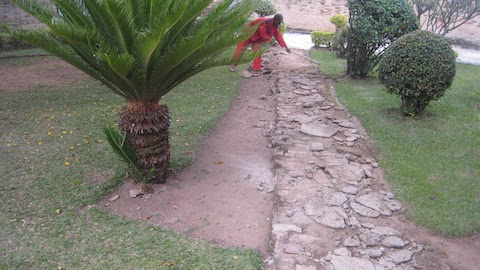
Before

After
Ever wonder what you can do to help?
Here’s a thought:
A great way is to support the Urukundo Sewing Center. A big help with a small gift.
We have a Sewing Center classroom nearly ready to start the new school year in 2020. We have no desks or chairs.
Yes, we need chairs for our students to sit on. These students are young adults.

The chair we wish to purchase is one with a side desk, thus saving on buying both a desk and chair. Economically, this is the best buy at US$30 each. We find if we were to buy a desk and chair separately, the cost would be US$60 for the two pieces. We try to save where we can. The metal frame will hold up better, and wood parts can be replaced, keeping the cost down. The chair is made here by our local vendor, so we help not only our economy but the economy in our district.
Donations can be sent to
Hope Made Real
Box 3222
Williamsport, Pa.
17701
or
Use the “donate now” button on the website, www.hopemadereal.org.
Thank you all for the generous donations.
Mama
Visitors from Austria
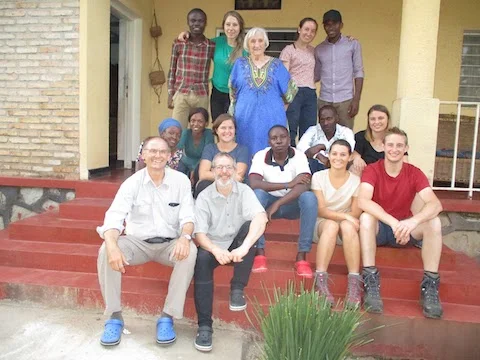
A yearly visitor to Urukundo is Dr. Otto Fischer, a doctor of veterinary medicine in Austria and founder and director of the NGO Future for Kids. This group is located in the Rwaza sector of Rwanda. He also founded a vet clinic. He brings many visitors to Rwanda from Austria, both vet students others. I am always glad to see him and his friends.
This time. Dr. Otto brought with him 12 aspiring young people on their way to graduating from veterinary school. It was our pleasure to have them tour Urukundo’s farm.
Andreas, Tamara, Lara and Clara came to Rwanda from the University of Veterinary Medicine in Vienna, Austria.
Anga, Esther, Prudence and Leandre are students at the University of Rwanda, Nyagatare campus.
With Dr. Otto was Dr. Thomas and his vet tech, Anna, from the animal clinic in Rankweil, Austria.
Visitors from Texas, USA

Dr. Casey Call and a delegation from the Karyn Purvis Institute of Child Development at Texas Christian University came to spend a few hours getting acquainted with Urukundo Learning Center and Village. An internship between Urukundo and Texas Christian is a possibility. We look forward to a closer relationship in the future.
It was our pleasure to share Urukundo’s history and goals with Jana Hunsley, Ashley West, Mindy Cook and Dr. Call, who is assistant director of the Karyn Purvis Institute.

Accompanying the visitors was Francoise Uzamukunda, a representative from the Global Engagement Institute in Rwanda.
Making new friends continues to be our goal at Urukundo Foundation.
Ok, so I am the short one. Don’t expect I will get taller.
August is the month for paying a call on our kids living away from home. Olive and Oswald had that honor.

Janette is doing well and growing. Olive took her a new friend, yellow bear.

Jason had asked Olive for a toy car last visit, so she took two cars for him this time. He is a happy boy.

Olive and Jason

This special boy worried us a bit on our last visit. Last time, Claude was not looking so good. We arranged for transportation for him to and from school and for him to have a nourishing lunch at school. We can see an improvement. We can still make a difference.

This smile warms the soul.
Jacob is doing well in his new home and school. Banita and Edison miss him so much. Notice the missing front teeth. He is that age, you know.
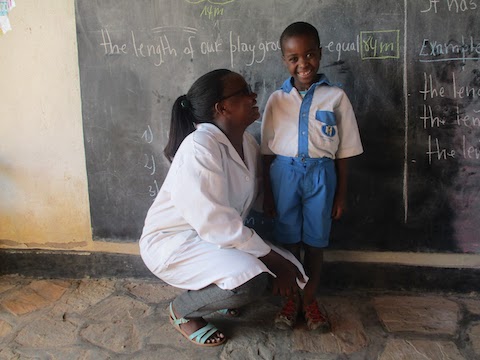
He is a charmer and so full of love to share.

Our driver Oswald and Jacob at Jacob’s school.

Kenny is growing tall. His school is in the background. He is finishing primary and will take the National Exam this October. He said he will do well. He is a good student. Kenny is one of the twins. Kenilla is his twin sister. We will visit her next week in Kigali where she lives with her grandfather. So sorry the twins are separated.
Old MacDonald had a farm and so does Mama Arlene.
I remember singing this song as a child and teaching it to my children and grandchildren. Here in Urukundo, our children also sing this song and in English.
We don't have all the animals in the song here on our farm.
We do have chickens.

Our egg layers are beautiful and productive. We do not have a cock-a-doodle-do.
Layers are a source of income. As the demand for eggs goes up, so will the number of layers. Seriously, no rooster. We buy our layers as day-old chicks.
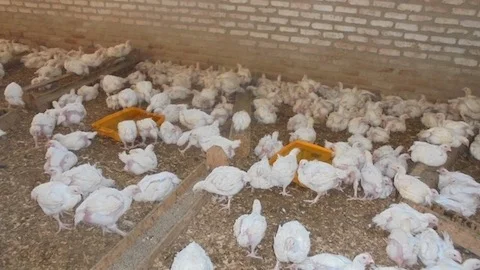
Broilers are also bought as day-old chicks. How fast they grow after only one month! They are sold after three months.

Pigs and piglets

Our mamas produce large litters.
The story of biogas:
Our pigs are a necessary part of our farm. We do not butcher pigs but sell the babies to private parties.
Now here is the cycle our pigs make possible. Our kitchen has many scraps as does the dining room. These scraps are fed to the pigs. Pigs provide manure for our biogas. Biogas is used in cooking the vegetables in the kitchen.The kitchen provides food for the pigs.
Hey, it cannot get better than that. A perfect round robin.
Cows. The one outside the shed is me. Oh, yah.


Love the little black and white calves (baby cows).

We have four cowboys and one intern: Pierre, Jean, intern Abais, Everist and Jovith.
We are honored that other schools choose the Urukundo farm to send their students as interns for further training.
Our boys who work the farm are actually called cowboys. No, they do not ride a horse, wear a 10-gallon hat, sing or play guitar. They also do not ride off into the sunset. That was only in movies from long ago. That was Gene Autry, Roy Rogers, Tex Ritter & Tom Mix. Showing my age.

Our mountainside farm.
Pigs at top, cows in middle, chickens on bottom.
Built one level at a time. Seems like the pigs should be on the bottom, not the top.
Drainage is well contained and not a problem as it is collected and used in biogas production.
A short history of the farm
Our farm started as a place purchased to move 40 chickens from the boys’ compound in
Gitarama town. When we rented a compound to start a home for boys, 40 chickens went with the property. Chicken dirt and little boys were not a good mix. We decided to move the chickens out into the country, so we bought a piece of land for that purpose. Not to move the boys, just the chickens. Later we moved the boys and all of Urukundo to this land. The cow first came as a wedding gift from one of our employees, so we needed a cow shed. A visitor from Ringgold, Pennsylvania, USA, decided we should have pigs. So like Topsy in “Uncle Tom’s Cabin” (age again) the farm just grew.
It is now a productive part of Urukundo Village.
News from the Farm
Bringing you up-to-date, farmwise.
At our last monitor and evaluation meeting, it was decided to reduce the number of cows from nine to three, not counting calves.
Owning cows means wealth in Rwanda, but providing grass and food for them is a big problem. We have tried different types of grasses and maize (corn) fodder. When you use the milk only for home use and not to sell, two fresh cows are enough. We do sell the calves, but that does not add up to enough income to support the cows.
What to do?
After much deliberation, it was decided to keep three cows, one for milk and two to produce babies. OK, maybe I am not so knowledgeable, but as I see it, one cow would be giving milk, another would be nearly ready to deliver and the third one would meet with a bull.
Make sense???
Where does the farm make its money? The chicken part of the farm is our main source of revenue. It was decided to convert all but three stalls for the cows into chicken houses.
With more than 100 laying hens, we use the eggs at the home and sell eggs in the community. We also sell young layers to beginning farmers. Chicken manure is also sold as garden fertilizer to community growers.
The largest number of chickens are broilers. These are raised on a rotating basis. We try to bring in day-old chicks every month as we sell full-grown broilers each month. Our customers are hotels, restaurants, schools, other NGOs and our village. On any given day, we have more than 3,000 broilers.
We are trying to get more customers, but we need to have more space for more chickens. We have an old building on the farm that can be torn down and a storage barn could be built.
The building has a bad roof and holes where small animals invade and birds fly in and eat the grain. It is also not a good size for storing food for the animals.

I thank you for the generous gifts you have sent so that we can continue to improve our farm and vaccinate our animals, pay our cowboys and buy food for the animals. We cannot grow enough food for the animals as land is scarce and the growing season short.
With more space we can up the production of broilers and purchase many more day-old chicks.
Our goal is for the farm to be self-sufficient someday or at least break even.
Donations for the advancement of the farm are so needed and appreciated.
Take a good look.

Down Memory Lane…some time later.
Celebrating the Fourth
The Fourth of July marks Independence Day for Americans. For Rwandans, the day marks Liberation Day.
So much has happened in late June and the month of July!
• Sports awards
• Social media and video development projects by visitors
• Sewing Center’s Level 1 accreditation by the Ministry of Education
• Construction of Sewing Center classroom
• Urukundo moving forward in educational development
• Worship Center serving children
• Textbooks for Urukundo Learning Center
A visit to our university house in Kigali. It’s unusual to find nine of the 10 kids at home at the same time. Perfect photo op. Dada (Pacifique) was in class so is not in the group. Oliver doesn’t start university until September. He then will move to the university house also.

Back row: Divine, Esperance, Bosco, Alexander, Abais
Front row: Giselle, Deborah, Cecelia, Lilliane
Bringing you, our long-time friends, up to date as to where the original 25 Urukundo kids are now. This group became family in 2006. Where are they in 2019?
The 11 above are or will be living the the university house. Solange is in Texas, USA, working on her master’s degree. Tresor is in California, USA, serving an internship in computer development after graduating in May 2019 from Arizona State University. John Paul, returned from Seattle, Washington, USA, after achieving his physical education certificate and is working at Urukundo Learning Center as a sports coach. Amin and Seraphina, with certificates in culinary arts, are on the job in Urukundo’s kitchen. Diescor is a medical student in school in Butare. Lucy and Fabrice are living with family and attending university. Anita, Anette, Emmanuel, Florentine, Savronia and Big Claude are now independent.
This accounts of all 25 of the first generation of Urukundo’s kids.
I am a very proud mama.